Showing posts with label bhakti. Show all posts

Monday, September 24, 2018

Magic

My sadhana has become very subtle, outside of my mind, beyond words. I live for my Beloved, who is all the forms of God and the Guru, all that is.

My Beloved, you hide in plain sight as everything, you love me as whomever you find in my heart. You draw me away from attachment to the world of the senses, to the place beyond, the place of magic I have longed for all my life.


Come, I will bring you across...
to me, to my world of magic,
for I created all of this,
I am all of this,
I am all that is inside
I am love
I am love
I am you

Friday, September 21, 2018

Faith of the heart

When the little tears start, and the stone at the center of my heart is softened, just a little, it is the moment when my lost faith is being rekindled.


Dearest Saint Therese of Lisieux, you said that you would spend your time in heaven doing good on earth.
Your trust in God was complete. Pray that He may increase my trust in His goodness and mercy as I ask for the following petitions…
That my faith in the deepest longings of my heart will be rekindled.
Pray for me that I, like you, may have great and innocent confidence in the loving promises of our God. Pray that I may live my life in union with God’s plan for me, and one day see the Face of God whom you loved so deeply.
Saint Therese, you were faithful to God even unto the moment of your death. Pray for me that I may be faithful to our loving God. May my life bring peace and love to the world through faithful endurance in love for God our savior.

Thursday, May 24, 2018

Become that place

When others talk to me, I remain steady inside. No more leaping and dancing with them. I look and sound like I am participating, and I am. But I am only participating by listening and talking. I do not squander my shakti. My state stays steady.

The motion and sound is often shocking, jarring and disturbing, I think particularly from people who are trying to subtly manipulate my state, i.e. codependents.


There is a stillness. I experience it at the center place, inside. l have become that place.


Photo: unknown (indecipherable)

Monday, April 23, 2018

Devotion

The poet saint Mirabai

I felt the pull of the magical love, the supernatural love from outside of life, forbidden, beyond what is known.

And I thought for a moment of the other things I "must" attend to first.

Immediately my entire being was filled with love, with a warmth and pressure that I chose to open to, again and again, praying it would stay.

I thought, "this is the love that I dissolve into."


My heart's desire. My heroine's quest. My story of stories.

Bhakti and devotion are the words I notice in the words of today.


Mirabai

My post on the SYP website:

Yesterday, as I sat contemplating the day's tasks, I felt myself filled to overflowing with a surge of love that was subtly permeating me, expanding my being and consciousness from within.
As I chose over and over to open to this love, I observed that this gentle force of constant expansion from within was the energy which will burn away my karmas and mental impurities, freeing my luminous being as I merge into this wider energy made of love.
I thought, "This is the love that I dissolve into." I felt that some gentle tears had begun.
I have reached for this feeling so many times since girlhood. My heart's desire. My heroine's quest. My story of stories. I have tried so many different ways to express a certain posture of worship and devotion within. It is becoming real at last!
Bhakti and devotion are the words I am finding in the words of my Guru and her teachers and devotees. Words from the very source of my joy.


Stava Cintamani

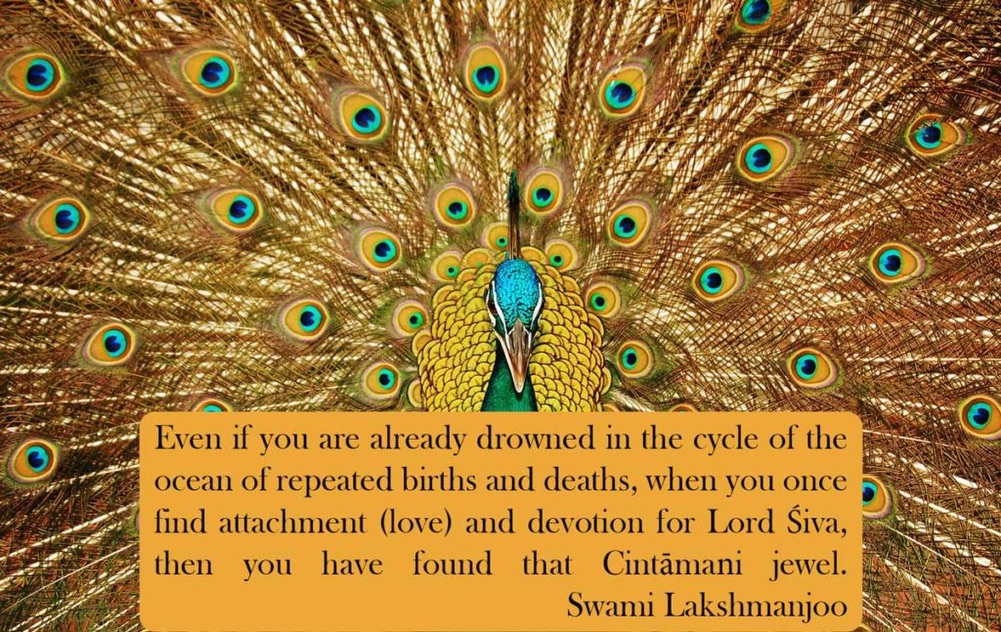
“Even if you are already drowned in the cycle of the ocean of repeated births and deaths, when you once find attachment (love) and devotion for Lord Śiva, then you have found that Cintāmaṇi jewel.”
~Swami Lakshmanjoo


Lakshmanjoo Academy News!
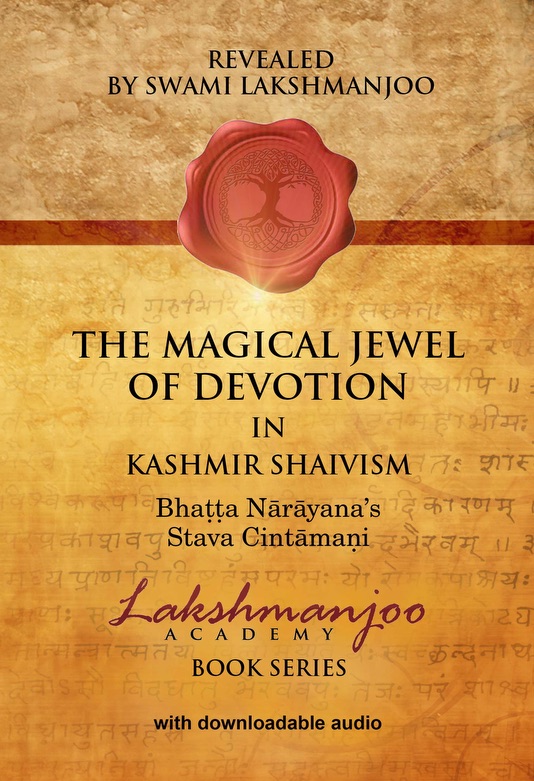
We are happy to announce the soon to be published newest addition to the Lakshmanjoo Academy book series:

The Magical Jewel of Devotion
in Kashmir Shaivism
Stava Cintamani

The 200 pages plus study set (free audio downloads included) will be released just in time for the annual Birthday Celebrations for Swami Lakshmanjoo on Tuesday the 9th of May.
ORDER NOW!! - PRE-SALE - Available for delivery at the end of May. You can pre-order your copy now by clicking on the image below… 


We will be studying this and other texts of Kashmir Shaivism at the upcoming Study Retreat, from 10th to 13th May following the Birthday celebrations. Read more here

“Even if you are already drowned in the cycle of the ocean of repeated births and deaths,
when you once find attachment (love) and devotion for Lord Śiva, then you have found that Cintāmaṇi jewel.” ~Swami Lakshmanjoo

Devotional hymns have always held an important place in the history of the “Monistic teachings of Kashmir Shaivism.” The recitation of such hymns is a common part of daily spiritual practice for many Shaiva aspirants.

Stava Cintāmaṇi – The Magical Jewel of Devotion in Kashmir Shaivism – is a sublime and unique hymn addressed to ‘Lord Shiva’, whom the author, Bhaṭṭa Nārāyaṇa  clearly holds as the Supreme Reality. Though highly devotional, these hymns are at the same time practical and deeply philosophical.

Swami Lakshmanjoo’s love for devotional hymns is evidenced by the fact that he translated and commented on the Stava Cintāmaṇi on three occasions. The first, in 1978, was recorded by John Hughes and forms the basis of this present publication. Then, in 1990, he gave an “impromptu translation” during which time Denise Hughes compiled extensive hand written notes. Lastly, in 1991, Swamiji recorded his recitation of the verses, giving brief translations to selected verses only.

Swamiji tells us that Bhaṭṭa Nārāyaṇa was one of the most important Kashmir Shaivite masters, and that he lived approximately one century before the illustrious Abhinavagupta (924-1020CE). This places Bhaṭṭa Nārāyaṇa somewhere between Vasugupta and Somānanda. Together these highly revered masters disseminated the foundational texts of a system of philosophy that would later become known exclusively as ‘Kashmir Shaivism’.

It was in the wake of this new revival that Bhaṭṭa Nārāyaṇa composed his Stavacintāmaṇ̣i. Little is known about his life, as he hardly mentions himself in his writings, but taking into account the spiritual climate of his generation, with the majority of the population being entrenched in dualistic and mono-dualistic practices, one could easily assume that he had composed his devotional hymn with the underlying intention of introducing and educating sincere spiritual aspirants in the ‘non-dual-monistic’ way of thought and practice. Since later commentators indicate that the Stava Cintāmaṇi was well received and highly influential, it is more than likely that Bhaṭṭa Nārāyaṇa achieved that goal.


That the author was endeavouring to enlighten his audience in the direction of non-dual Shaivism is clearly visible in the inclusion of his interpretation of the ancient and highly revered Gāyatri mantra, where he says:

“I don’t care to possess that effulgent light (tat savitur varenyam) of the three worlds (bhuḥ, bhuvaḥ and svaḥ), and I don’t need my intellect elevated to the state of universal understanding (dhiyo yo naḥ pracodayāt); I want only for that effulgent light to direct me on the path of Shaivism – that is all I long for – and that is the only favor I ask of Gāyatrī.”

Longing for this experience the author sings:

“O Lord Shiva, let me merge in Your nature of God consciousness everywhere, so whatever I do in the dreaming state, whatever I say in this daily routine of life, good or bad, let that become divine, and let that be reflected in the mirror of God consciousness always. Let me merge in God consciousness in each and every respect of the daily routine of life, not only at the time of meditation.”

In his hymn, Bhaṭṭa Nārāyaṇa not only addresses this flow of consciousness into the world, but also its flowing back, from the world to its origin – the state of God consciousness. This he perceives in the simple act of bowing, which to him is the ultimate expression of love and devotion towards God. The constant theme that runs like a thread through the one hundred and twenty verses (ślokas) of the Stava Cintāmaṇi is that love and devotion (bhakti towards Lord Shiva) is everything.


The Magical Jewel of Devotion in Kashmir Shaivism - Stava Cintamani


Swami Lakshmanjoo was so excited to share this particular hymn with the world that when leaving his Ashram en-route to America in February of 1991, he carried a copy of Stava Cintāmaṇi safely tucked under his arm. A few days after his arrival in Los Angeles he sat in the early hours of the morning and recited all the verses of this treasured hymn. This was Swamiji’s last translation of this Magical Jewel of Devotion in Kashmir Shaivism – Stava Cintāmaṇi.


Wednesday, April 11, 2018

Thy feet


I touch with the edge of the far-spreading wing of my song 
thy feet which I could never aspire to reach.

~ Rabindranath Tagore


Monday, April 9, 2018

Rest

Photo from Jnaneshwar's Samadhi Mandir

In the guru, my life force finds rest.

~ Jnaneshwar Maharaj


Sunday, February 11, 2018

Bhagavad Gita: The Four Yogas

My sadhana has been juggled around, and is moving in a new direction. I believe my Guru has been leading all of us up to and through this change.

I have to realize that actions that attempt to use discipline to overcome my limitations and delusions currently never work for me. I have spent my whole life disciplining myself and wildly grasping with super-human effort to try to get the grand experience I have been seeking, and to address what has been missing, and my misery about this.

For me, the "dos" like disciplining my activities with specific goals about meditation and other practices, as well as trying to keep spiritual experiences permanent, are not the opposite of sadhana. ALWAYS using my life and moments to try to create a new and permanent state is based on a delusion that I am lost, unfulfilled, away from God. Grasping and doing for my own limited results has created huge karmas and samskaras for me.

I found myself writing about how Karma and Bhakti Yoga--and much of Jnana Yoga--have come to the fore in my sadhana. The fourth Yoga, Raja Yoga, is a synthesis, with elements that form a system based on discipline, which is not helpful for me.

Krishna talks about how an individual will find that some yogas will work for them better than others.


1) KARMA YOGA~THE YOGA OF ACTION: Any time I am grasping or pushing, trying or making myself do anything, I am jumping on the great wheel. The harder I push and hang on, the harder I'm going to fall when the wheel goes around the other way. Rajas creates karma. I've got way too much longing made into rajas in every moment!

My path is not doing, and it is not not-doing. HOW? Through dharma/duty. Lord Krishna has taught me about Karma Yoga, and this knowledge and yoga is very important to my sadhana.


2) BHAKTI YOGA: Bhakti Yoga is a new emphasis for me. It is divine love, longing, and worship in a personal relationship with a chosen form of the divine. This is the "doing" that I offer, avoiding karmas (Karma Yoga). Commitment to experiencing love and worship for the Divine fills me with an intensity of shakti that is burning my impurities away.

A short description of a very powerful yoga.


3) JNANA YOGA: The focus of my sadhana for the last few years has been to notice and name the elements of my mind in action. I challenge delusion by noticing what arises and holding what will bring delusion. When I hold a train of thought or etc., it naturally dissolves. Consciousness dissolves into consciousness.

I have for the most part eliminated self-pity, collapsing (giving up), and self-hatred, and I at least notice many things such as jealousy, anger, and competitiveness. I especially have benefited from noticing when I begin to make a story about what is happening in the moment, with the assumption that it is happening to me.

My mind has become much more still and centered.

Other parts of Jnana Yoga which have been important are recognizing what is transitive in my reality and letting go my attachments to these things. "That's not real," and "that isn't permanent" are my mantras in using my mind in this way. I also practice "seeing" the world of the senses as consciousness, and remembering it may promise many things, but none of it will be truly satisfying or permanent.


4) RAJA YOGA: Royal Raja Yoga is a higher yoga that incorporates elements of the other yogas in a powerful synthesis. It is based on meditation and other tools to work with the mind.

Systematic and disciplined is not helpful or useful to me at this point in my sadhana. When I meditated, I went after dinner. I wanted to meditate. I ran down the steps to the kriyaloka meditation room at the ashram, sinking into my spot, my consciousness dropping into the depths of me as I settled in.

"It's almost 7:00, time to meditate doesn't work for me, at least not now. I have to wrestle with myself about it, my intention, and my fear. It is very unpleasant. It runs me, and I am stuck with it.

I need to go around this stuff. I realize almost all(?) yogis do this. I think I did so much of this in a past life that this time I am doing something else.

Thursday, January 25, 2018

Jagadanandana

"If you want to advance on the path of suddha bhakti, not many rules and spiritual practices are necessary. Simply beg for the complete shelter of krsna-nama and thus purify your heart and consciousness."

Srila Gauranga's instructions are for grhastas as well as vairagi devotees. He said:
"Take great care not to let a moment pass without uttering krsna-nama."

From the teachings of Srila Jagadanandana Pandita


Photo: Bhakti Vedanta Book Trust Intl

You are visitor number

Search my blog

Select Language


Most popular posts


Search Hinduism and Sanskrit terms

Search results


Receive my delicious posts via email!