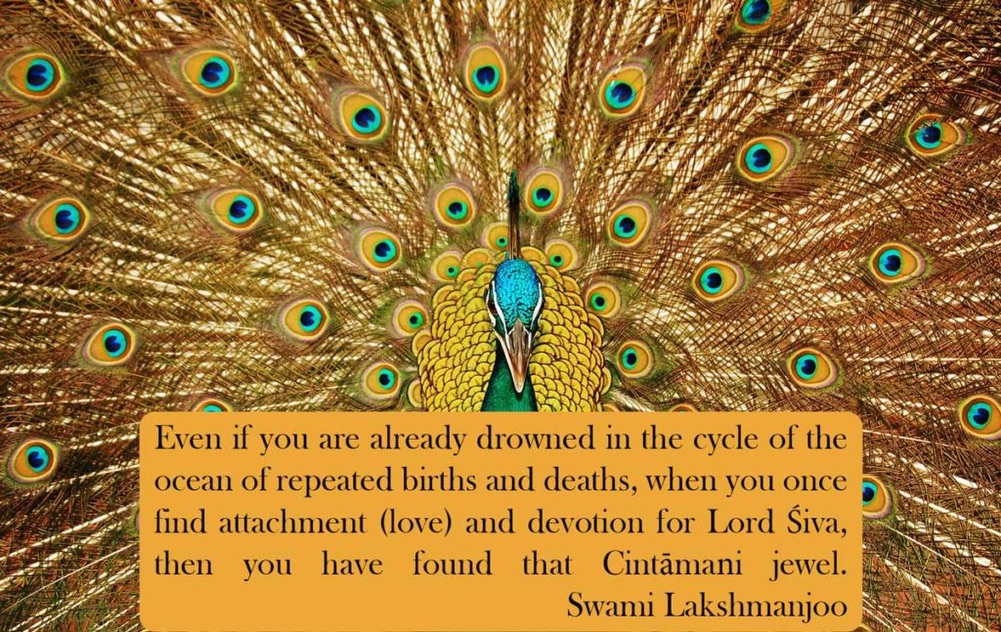
“Even if you are already drowned in the cycle of the ocean of repeated births and deaths, when you once find attachment (love) and devotion for Lord Śiva, then you have found that Cintāmaṇi jewel.”
~Swami Lakshmanjoo
Lakshmanjoo Academy News!
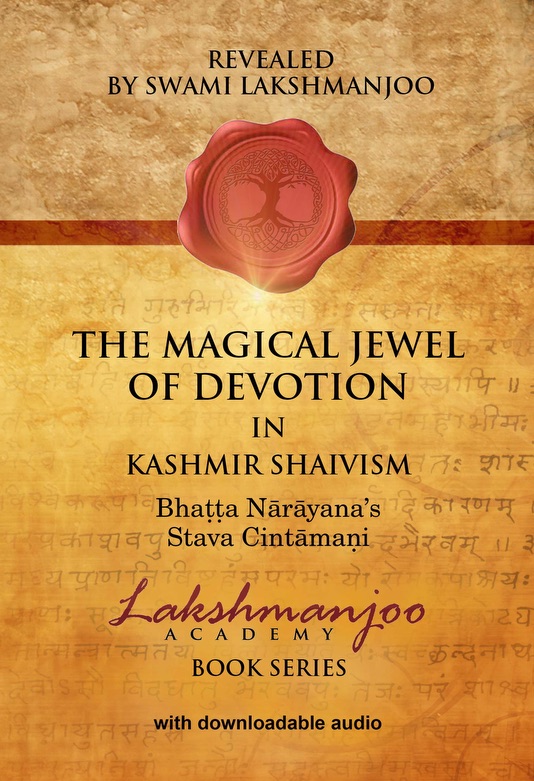
We are happy to announce the soon to be published newest addition to the Lakshmanjoo Academy book series:
The Magical Jewel of Devotion in Kashmir Shaivism Stava Cintamani
The 200 pages plus study set (free audio downloads included) will be released just in time for the annual Birthday Celebrations for Swami Lakshmanjoo on Tuesday the 9th of May.
ORDER NOW!! - PRE-SALE - Available for delivery at the end of May. You can pre-order your copy now by clicking on the image below…
We will be studying this and other texts of Kashmir Shaivism at the upcoming Study Retreat, from 10th to 13th May following the Birthday celebrations. Read more here…
“Even if you are already drowned in the cycle of the ocean of repeated births and deaths, when you once find attachment (love) and devotion for Lord Śiva, then you have found that Cintāmaṇi jewel.” ~Swami Lakshmanjoo
Devotional hymns have always held an important place in the history of the “Monistic teachings of Kashmir Shaivism.” The recitation of such hymns is a common part of daily spiritual practice for many Shaiva aspirants.
Stava Cintāmaṇi – The Magical Jewel of Devotion in Kashmir Shaivism – is a sublime and unique hymn addressed to ‘Lord Shiva’, whom the author, Bhaṭṭa Nārāyaṇa clearly holds as the Supreme Reality. Though highly devotional, these hymns are at the same time practical and deeply philosophical.
Swami Lakshmanjoo’s love for devotional hymns is evidenced by the fact that he translated and commented on the Stava Cintāmaṇi on three occasions. The first, in 1978, was recorded by John Hughes and forms the basis of this present publication. Then, in 1990, he gave an “impromptu translation” during which time Denise Hughes compiled extensive hand written notes. Lastly, in 1991, Swamiji recorded his recitation of the verses, giving brief translations to selected verses only.
Swamiji tells us that Bhaṭṭa Nārāyaṇa was one of the most important Kashmir Shaivite masters, and that he lived approximately one century before the illustrious Abhinavagupta (924-1020CE). This places Bhaṭṭa Nārāyaṇa somewhere between Vasugupta and Somānanda. Together these highly revered masters disseminated the foundational texts of a system of philosophy that would later become known exclusively as ‘Kashmir Shaivism’.
It was in the wake of this new revival that Bhaṭṭa Nārāyaṇa composed his Stavacintāmaṇ̣i. Little is known about his life, as he hardly mentions himself in his writings, but taking into account the spiritual climate of his generation, with the majority of the population being entrenched in dualistic and mono-dualistic practices, one could easily assume that he had composed his devotional hymn with the underlying intention of introducing and educating sincere spiritual aspirants in the ‘non-dual-monistic’ way of thought and practice. Since later commentators indicate that the Stava Cintāmaṇi was well received and highly influential, it is more than likely that Bhaṭṭa Nārāyaṇa achieved that goal.
That the author was endeavouring to enlighten his audience in the direction of non-dual Shaivism is clearly visible in the inclusion of his interpretation of the ancient and highly revered Gāyatri mantra, where he says:
“I don’t care to possess that effulgent light (tat savitur varenyam) of the three worlds (bhuḥ, bhuvaḥ and svaḥ), and I don’t need my intellect elevated to the state of universal understanding (dhiyo yo naḥ pracodayāt); I want only for that effulgent light to direct me on the path of Shaivism – that is all I long for – and that is the only favor I ask of Gāyatrī.”
Longing for this experience the author sings:
“O Lord Shiva, let me merge in Your nature of God consciousness everywhere, so whatever I do in the dreaming state, whatever I say in this daily routine of life, good or bad, let that become divine, and let that be reflected in the mirror of God consciousness always. Let me merge in God consciousness in each and every respect of the daily routine of life, not only at the time of meditation.”
In his hymn, Bhaṭṭa Nārāyaṇa not only addresses this flow of consciousness into the world, but also its flowing back, from the world to its origin – the state of God consciousness. This he perceives in the simple act of bowing, which to him is the ultimate expression of love and devotion towards God. The constant theme that runs like a thread through the one hundred and twenty verses (ślokas) of the Stava Cintāmaṇi is that love and devotion (bhakti towards Lord Shiva) is everything.
Swami Lakshmanjoo was so excited to share this particular hymn with the world that when leaving his Ashram en-route to America in February of 1991, he carried a copy of Stava Cintāmaṇi safely tucked under his arm. A few days after his arrival in Los Angeles he sat in the early hours of the morning and recited all the verses of this treasured hymn. This was Swamiji’s last translation of this Magical Jewel of Devotion in Kashmir Shaivism – Stava Cintāmaṇi.
My "go to" dharana/dhyana. My focus and practice. My contemplation.
My "go to" dhyana is to nudge myself out of multiplicity. I experience myself as formless, unlimited consciousness, the knower, and everything else a play of consciousness on the screen of life, the known. The play normally seems three-dimensional because of the magic of maya.
Inherent in this contemplation is acknowledging that the projection of maya cannot satisfy/protect me, or cause lack/harm me. Thinking otherwise is bondage.
I want freedom. I see myself "unlatching" from the screen of the world going by. I let the illusion of satisfaction and lack slip away. It becomes a dance of light. And I choose freedom, the source. The real prize.
I can only do this because of the grace of my guru, because I have received shaktipat.
Step well
I also use my mind to slip out from the experience of multiplicity. When I am in this state, I experience Oneness, One without second. A singularity. My awareness resides in the great consciousness, the only Self. Immediately I am filled with great bliss.
I can reshape my consciousness like this for several moments at a time.
An interesting aside is that my ability to shape my own consciousness was greatly improved by my years in Wicca, where "spells" are created by this containing and shaping of awareness, a discipline and practice that grows in effectiveness over time.
I also use this skill as a writer of fiction.
Swami Lakshmanjoo:
The word dhyana means “contemplation.” It is another mode in anavopaya (a means of enlightenment). Dhyana is contemplation on some point.
There are different forms of dhyana. For example, you are practicing dhyana when you contemplate on the lotus in your heart, or on the meaning of some mantra such as the mantra “so’ham” or the mantra “Shiva.”
This is a higher form of anavopaya because it is contemplation without any shape, without any form. If you were to contemplate on Lord Shiva as having a particular form, a particular shape, that is a lower form of anavopaya. It is contemplation with form.
When that time will come? I want to ask You, when that day will come for me, when that day will appear, when I will leave all other things, all of the other activities of the world, and be focused only to that point, i.e., just to embrace You and taste the nectar of that nearness of that devotion, love? When that day will come for me? Tell me.
You are behind the eyes of all of the teachers. An immense power. Drawing me. Dissolving me.
A penetrating prick to my ego. Once broken, freedom is inevitable.
I've escaped, because of GRACE.
All that is left is karmas and samskaras--debts from action,
distortions and deluded habits, burning up in the sacred fire.
Swami Lakshmanjoo
Look at their eyes. They all see "in," as well as "out."
You can tell he is inside ~ a beloved Brahmin priest in Varanasi
Shree Shree Ravi Shankar
Smiling or not. Open or closed. Eyes that see in. An ego pierced. The outer world does not touch them.
There is no "external" world to touch them.
H.H. 17th Gyalwang Karmapa Trinley Thaye Dorje
H.H. 17th Gyalwang Karmapa Ogyen Trinley Dorje
HH 16th Gyalwang Karmapa Rangjung Rigpe Dorje
The shakti of the senses has been withdrawn from the sense objects.
INTRODUCTION: "This
is my new commentary on this Bhagavad
Gītā."
Swami Lakshmanjoo exclaims, as he tells us what we should do when
eating and while experiencing śabda
(sound),
sparśa (touch),
rupa
(form) . . . all of the sensual pleasures.
Although
this verse of the Bhagavad
Gītā
by Vyāsa is complete,186
but Abhinavagupta has not commentated upon it as I would commentate
upon this śloka.
I will tell you his commentary, his first commentary, [which he gave]
in his first life.
Āhāra means
āhriyamāṇeṣu viṣayeṣu [comm.],
when you will go here and there–this is āhāra.
Yuktāhāra
does not [only] mean eating. Yuktāhāra
means śabda
(sound),sparśa
(touch),
rupa
(form) . . . all of the sensual pleasures.
In
sensual pleasures, what should you do?
Keep
it on one side, vihāra.
Vihāra
means vihāraḥupa-bhogāya
pravṛttiḥ;
vihāra
means to enjoy sensual objects. This was Abhinavagupta’s first
commentary.
Tasyāśca
yuktatvaṁ.
Yukta
means,
na
ātyantā saktiḥ na ātyanta parivarjanam,
you should not be a slave to those enjoyments. Neither should you
become a slave nor should you renounce them. Renunciation is also not
good and to be a slave to those enjoyments, that is also not good.
That is yukta,
yuktatva.
Evaṁ
sarvatra,
in this way you should commentate upon these ślokas
of Vyāsa. This is Abhinavagupta’s first commentary. But I don't appreciate this kind of [explanation].
Yuktāhāra. Yuktāhāra means take food! Go on taking food, as much food as you can take, go on
taking it but keep awareness in it. While taking food, offer it to
your own God–that is yuktāhāra.
Yuktāhāra
means when you eat food, go on eating it with awareness, go on
focusing on its taste. Which taste? The taste of whatever you eat . .
. and there will be one-pointedness. Maintain one-pointedness while
eating. Maintain one-pointedness–it is my commentary, my
amendment–maintain one-pointedness in sleeping. You can sleep but
maintain one-pointedness in sleeping, be aware while sleeping. If you
sleep, be aware! Don’t be just like a sluggish bear sleeping. Put
the trick of yoga
into it.
This
is my new commentary on this Bhagavad
Gītā.
Yuktāhāra
vihārasya yuktaceṣṭasya karmasu.
When you have to do activities of the daily routine of your life, do
all of the daily routine of life, but don’t lose your internal
yoga.
At the same time, you [should] go on practicing inside.
DENISE:
You
mean watching your breath. SWAMIJI: Watching
your breath and don’t be taken by these activities of life, the
daily routine of life.
Yukta
svapnā,
and when you dream, go into dreams with awareness. When you dream,
you will enter into samādhi
at the time of dreaming state; you won’t go into the dreaming
state. At that time, you will go into samādhi
while dreaming.
Yukta
svapna āvabodhasya,
and when you are awake, be awake with yoga.
Yogo
bhavati duḥkha,
then yoga
is very easy; everywhere yoga
is available to you. This is my commentary, new commentary. And this
is Abhinavagupta’s new commentary. You should know that. So I had
to [make an] amendment on this commentary.
yogo’sti
naivātyaśato na caikāntamanaśnataḥ /
na
cātisvapnaśīlasya nātijāgarato’rjuna
//17//
[repeated]
Yukta means yujaryoge.
According to Pāṇini’s grammar, yukta
means “with yoga”.
Attach yoga
to all of your activities of the daily routine of life and yoga
will be very easily achieved. Yoga
cannot be achieved [by remaining] in one corner. If you lock your
door from the outside and sit, you will just be wasting your time
inside. You will be . . . “idles workshop is demons . . .” what?
DENISE: Idle
mind is devil’s workshop?
JONATHAN: Devil’s
playground. Idle workshop is devil’s playground.
SWAMIJI: Yes. Don't do like that. Come out in the field and see yoga!
____________
186
“Then who is the real yogī
then? Yuktāhāravihārasya,
you should take food in less quantity. You should do your worldly
activity, [but] very little activity. Don’t become victim of your
business. Yuktaceṣṭasya
karmasu,
don’t think too much. Think very little. Not thinking at all,
anything, that is not [advisable either]–yoga
won’t take place. Think a little. Think of something, but not too
much. Yuktasvapnāvabodhasya,
and go to dreaming state also, but not always. Yogo
bhavati duhkha,
for that person, yogabecomes
successful and very easy to be obtained. Those actions should be done
in moderate way. Don’t see pictures day and night, always. See
pictures after a fortnight. That is good, that will lead you to yoga.
But [if you are] not seeing pictures at all, [then] those pictures
will leak in your mind then, and you will be filled with pictures in
your mind. So do something, but very little, in moderation. Don’t
be too much attached to it [and] don’t be detached to it at the
same time. Detachment [and] attachment should be done moderately, in
a moderate way.” Ibid.