Showing posts with label Kashmir Shaivism. Show all posts

Monday, April 23, 2018

Stava Cintamani

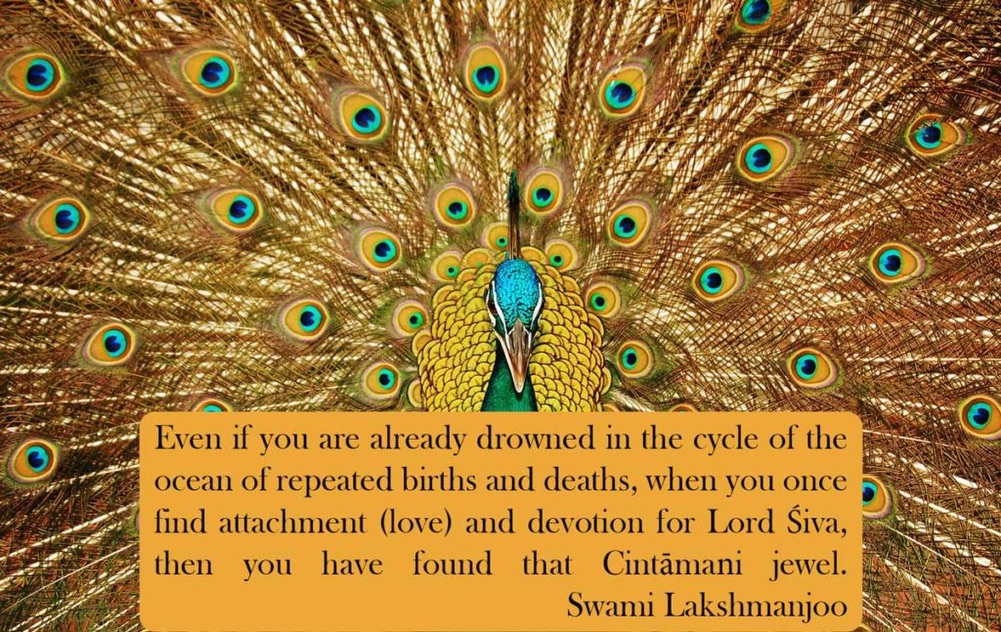
“Even if you are already drowned in the cycle of the ocean of repeated births and deaths, when you once find attachment (love) and devotion for Lord Śiva, then you have found that Cintāmaṇi jewel.”
~Swami Lakshmanjoo


Lakshmanjoo Academy News!
We are happy to announce the soon to be published newest addition to the Lakshmanjoo Academy book series:

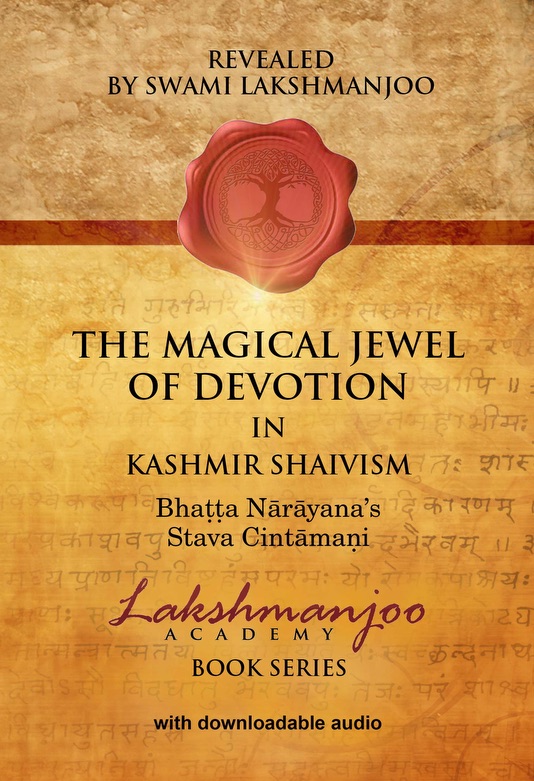
The Magical Jewel of Devotion
in Kashmir Shaivism
Stava Cintamani

The 200 pages plus study set (free audio downloads included) will be released just in time for the annual Birthday Celebrations for Swami Lakshmanjoo on Tuesday the 9th of May.
ORDER NOW!! - PRE-SALE - Available for delivery at the end of May. You can pre-order your copy now by clicking on the image below… 


We will be studying this and other texts of Kashmir Shaivism at the upcoming Study Retreat, from 10th to 13th May following the Birthday celebrations. Read more here

“Even if you are already drowned in the cycle of the ocean of repeated births and deaths,
when you once find attachment (love) and devotion for Lord Śiva, then you have found that Cintāmaṇi jewel.” ~Swami Lakshmanjoo

Devotional hymns have always held an important place in the history of the “Monistic teachings of Kashmir Shaivism.” The recitation of such hymns is a common part of daily spiritual practice for many Shaiva aspirants.

Stava Cintāmaṇi – The Magical Jewel of Devotion in Kashmir Shaivism – is a sublime and unique hymn addressed to ‘Lord Shiva’, whom the author, Bhaṭṭa Nārāyaṇa  clearly holds as the Supreme Reality. Though highly devotional, these hymns are at the same time practical and deeply philosophical.

Swami Lakshmanjoo’s love for devotional hymns is evidenced by the fact that he translated and commented on the Stava Cintāmaṇi on three occasions. The first, in 1978, was recorded by John Hughes and forms the basis of this present publication. Then, in 1990, he gave an “impromptu translation” during which time Denise Hughes compiled extensive hand written notes. Lastly, in 1991, Swamiji recorded his recitation of the verses, giving brief translations to selected verses only.

Swamiji tells us that Bhaṭṭa Nārāyaṇa was one of the most important Kashmir Shaivite masters, and that he lived approximately one century before the illustrious Abhinavagupta (924-1020CE). This places Bhaṭṭa Nārāyaṇa somewhere between Vasugupta and Somānanda. Together these highly revered masters disseminated the foundational texts of a system of philosophy that would later become known exclusively as ‘Kashmir Shaivism’.

It was in the wake of this new revival that Bhaṭṭa Nārāyaṇa composed his Stavacintāmaṇ̣i. Little is known about his life, as he hardly mentions himself in his writings, but taking into account the spiritual climate of his generation, with the majority of the population being entrenched in dualistic and mono-dualistic practices, one could easily assume that he had composed his devotional hymn with the underlying intention of introducing and educating sincere spiritual aspirants in the ‘non-dual-monistic’ way of thought and practice. Since later commentators indicate that the Stava Cintāmaṇi was well received and highly influential, it is more than likely that Bhaṭṭa Nārāyaṇa achieved that goal.


That the author was endeavouring to enlighten his audience in the direction of non-dual Shaivism is clearly visible in the inclusion of his interpretation of the ancient and highly revered Gāyatri mantra, where he says:

“I don’t care to possess that effulgent light (tat savitur varenyam) of the three worlds (bhuḥ, bhuvaḥ and svaḥ), and I don’t need my intellect elevated to the state of universal understanding (dhiyo yo naḥ pracodayāt); I want only for that effulgent light to direct me on the path of Shaivism – that is all I long for – and that is the only favor I ask of Gāyatrī.”

Longing for this experience the author sings:

“O Lord Shiva, let me merge in Your nature of God consciousness everywhere, so whatever I do in the dreaming state, whatever I say in this daily routine of life, good or bad, let that become divine, and let that be reflected in the mirror of God consciousness always. Let me merge in God consciousness in each and every respect of the daily routine of life, not only at the time of meditation.”

In his hymn, Bhaṭṭa Nārāyaṇa not only addresses this flow of consciousness into the world, but also its flowing back, from the world to its origin – the state of God consciousness. This he perceives in the simple act of bowing, which to him is the ultimate expression of love and devotion towards God. The constant theme that runs like a thread through the one hundred and twenty verses (ślokas) of the Stava Cintāmaṇi is that love and devotion (bhakti towards Lord Shiva) is everything.


The Magical Jewel of Devotion in Kashmir Shaivism - Stava Cintamani


Swami Lakshmanjoo was so excited to share this particular hymn with the world that when leaving his Ashram en-route to America in February of 1991, he carried a copy of Stava Cintāmaṇi safely tucked under his arm. A few days after his arrival in Los Angeles he sat in the early hours of the morning and recited all the verses of this treasured hymn. This was Swamiji’s last translation of this Magical Jewel of Devotion in Kashmir Shaivism – Stava Cintāmaṇi.


Wednesday, October 11, 2017

The end of delusion

My mind keeps running around! Around!! GET BACK HERE.

My mind might run, but I'm the one who likes and believes in the feelings of gratification it seeks. I choose to pursue them.

Tiny little lights that sparkle and charm, that make me shimmy a little with excitement and release. In this way I miss out on the true treasure.


The Guru's feet symbolize a divine mystery, the place where Guru
and disciple meet as One in the ocean of divine consciousness

The place of action is to look at it, to put consciousness on it. What is this? Why do I pursue soimething that is not really there?? I believe over and over in gratification, and think I am achieving it, even if only for a moment. More pursuit. Repeat.

It's a sparkle!. A shimmer! A happy shimmy! No more. NO SUBSTANCE.

I want what is real.

I have disciplined my mind in key ways. This is next. I no longer believe in gratification.

"I don't believe in ________" is my playful way of saying _________ is an illusion."*

I don't believe in suffering. Suffering comes from wrong thinking. It is only consciousness. Nothing happens to me.

Now, I do not believe in gratification. Believing in it is followed closely by thinking I am experiencing lack, or frustration. None of these things are actually happening to me.

I don't want to fly on this mental swing, mistaken storymaking anymore.

Consciousness dissolves consciousness. 


The place at the Guru's feet is a place of surrender which transcends the physical.
The physical Guru offers service to Her disciples by accepting this worship of
Paramashiva, the Guru that is all. Worship at this place is beyond profound.

*In Kashmir Shaivism, everything is made of divine consciousness, which is real. This includes consciousness as delusion. Everything. It isn't things or consciousness that are not real. 
The beginning of delusion is to believe in something that is false. The experience of delusion is persisting in being mistaken.


Friday, September 22, 2017

I am God in motion

I am God in motion. 
"Space and time are God's way of making sure everything doesn't happen at the same time and in the same place." ~ unknown


Saturday, July 22, 2017

The essence of my sadhana is one-pointedness

Swami Lakshmanjoo commentary: Bhagavad Gita Chapter 6, verses 17-18

INTRODUCTION: "This is my new commentary on this Bhagavad Gītā." Swami Lakshmanjoo exclaims, as he tells us what we should do when eating and while experiencing śabda (sound), sparśa (touch), rupa (form) . . . all of the sensual pleasures.
In sensual pleasures, what should you do?


video of Swami Lakshmanjoo
DVD 6.2 (23:22)


Source: Bhagavad Gita, in the Light of Kashmir Shaivism, revealed by Swami Lakshmanjoo
All Content subject to copyright © John Hughes
Permission for reprint granted
Emphasis mine
Permission for reprint pending


युक्ताहारविहारस्य युक्तचेष्टस्य कर्मसु ।
युक्तस्वप्नावबोधस्य योगो भवति दुःखहा ॥१८॥
yuktāhāravihārasya yuktaceṣṭasya karmasu /
yuktasvapnāvabodhasya yogo bhavati duhkhahā //18//

Although this verse of the Bhagavad Gītā by Vyāsa is complete,186 but Abhinavagupta has not commentated upon it as I would commentate upon this śloka. I will tell you his commentary, his first commentary, [which he gave] in his first life.

Āhāra means āhriyamāṇeṣu viṣayeṣu [comm.], when you will go here and there–this is āhāra. Yuktāhāra does not [only] mean eating. Yuktāhāra means śabda (sound),sparśa (touch), rupa (form) . . . all of the sensual pleasures.

In sensual pleasures, what should you do?

Keep it on one side, vihāra. Vihāra means vihāraḥ upa-bhogāya pravṛttiḥ; vihāra means to enjoy sensual objects. This was Abhinavagupta’s first commentary.

Tasyāśca yuktatvaṁ. Yukta means, na ātyantā saktiḥ na ātyanta parivarjanam, you should not be a slave to those enjoyments. Neither should you become a slave nor should you renounce them. Renunciation is also not good and to be a slave to those enjoyments, that is also not good. That is yukta, yuktatva.

Evaṁ sarvatra, in this way you should commentate upon these ślokas of Vyāsa. This is Abhinavagupta’s first commentary. But I don't appreciate this kind of [explanation]. 

Yuktāhāra. Yuktāhāra means take food! Go on taking food, as much food as you can take, go on taking it but keep awareness in it. While taking food, offer it to your own God–that is yuktāhāra. Yuktāhāra means when you eat food, go on eating it with awareness, go on focusing on its taste. Which taste? The taste of whatever you eat . . . and there will be one-pointedness. Maintain one-pointedness while eating. Maintain one-pointedness–it is my commentary, my amendment–maintain one-pointedness in sleeping. You can sleep but maintain one-pointedness in sleeping, be aware while sleeping. If you sleep, be aware! Don’t be just like a sluggish bear sleeping. Put the trick of yoga into it.

This is my new commentary on this Bhagavad Gītā.

Yuktāhāra vihārasya yuktaceṣṭasya karmasu. When you have to do activities of the daily routine of your life, do all of the daily routine of life, but don’t lose your internal yoga. At the same time, you [should] go on practicing inside.

DENISE:
You mean watching your breath.

SWAMIJI:
Watching your breath and don’t be taken by these activities of life, the daily routine of life.


In sensual pleasures, what should you do? (in Kashmir Shaivism) ~Swami Lakshmanjoo


Yukta svapnā, and when you dream, go into dreams with awareness. When you dream, you will enter into samādhi at the time of dreaming state; you won’t go into the dreaming state. At that time, you will go into samādhi while dreaming.

Yukta svapna āvabodhasya, and when you are awake, be awake with yoga. Yogo bhavati duḥkha, then yoga is very easy; everywhere yoga is available to you. This is my commentary, new commentary. And this is Abhinavagupta’s new commentary. You should know that. So I had to [make an] amendment on this commentary.

yogo’sti naivātyaśato na caikāntamanaśnataḥ /
na cātisvapnaśīlasya nātijāgarato’rjuna
//17// [repeated]

Yukta means yujaryoge. According to Pāṇini’s grammar, yukta means “with yoga”. Attach yoga to all of your activities of the daily routine of life and yoga will be very easily achieved. Yoga cannot be achieved [by remaining] in one corner. If you lock your door from the outside and sit, you will just be wasting your time inside. You will be . . . “idles workshop is demons . . .” what?

DENISE: Idle mind is devil’s workshop?

JONATHAN: Devil’s playground. Idle workshop is devil’s playground.

SWAMIJI: Yes. Don't do like that. Come out in the field and see yoga!


____________
186 “Then who is the real yogī then? Yuktāhāravihārasya, you should take food in less quantity. You should do your worldly activity, [but] very little activity. Don’t become victim of your business. Yuktaceṣṭasya karmasu, don’t think too much. Think very little. Not thinking at all, anything, that is not [advisable either]–yoga won’t take place. Think a little. Think of something, but not too much. Yuktasvapnāvabodhasya, and go to dreaming state also, but not always. Yogo bhavati duhkha, for that person, yogabecomes successful and very easy to be obtained. Those actions should be done in moderate way. Don’t see pictures day and night, always. See pictures after a fortnight. That is good, that will lead you to yoga. But [if you are] not seeing pictures at all, [then] those pictures will leak in your mind then, and you will be filled with pictures in your mind. So do something, but very little, in moderation. Don’t be too much attached to it [and] don’t be detached to it at the same time. Detachment [and] attachment should be done moderately, in a moderate way.” Ibid.

Source:
Bhagavad Gita, in the Light of Kashmir Shaivism, revealed by Swami Lakshmanjoo
All Content subject to copyright © John Hughes
Permission for reprint granted


Friday, November 25, 2016

Sri Yantra

The Sri Yantra is a mystical diagram formed by nine interlocking triangles that surround and radiate out from a central (bindu) point. It is worshiped as a form of the divine in Hindu tantra, which is based on the Hindu philosophy of Kashmir Shaivism.

The Sri Yantra expresses Advaita or non-duality, which includes the union of the Masculine and the Feminine Divine. Four upward triangles represent Shiva or the Masculine, which is potentiality, while five downward triangles symbolize the female embodiment of Shakti, from whom all creation is made.

Together the nine triangles are interlaced in such a way as to form 43 smaller triangles in a web symbolic of the entire cosmos or a womb symbolic of creation. The triangles are of various sizes and intersect with one another in various ways, creating three-dimensional patterns. In the middle is the power point (bindu), visualizing the highest, seeming elusive center from which the entire figure and the cosmos expand.

The Yantra is a way to express the form of the divine, but also serves as a vehicle. It moves the gaze and consciousness of the viewer into the center, where all consciousness as multiplicity resolves back into the One.
Based in part upon Wikipedia: Sri Yantra


 Google FeedBurner

Wednesday, March 23, 2016

Very cool... and delicious

"May 21, 2013 ~ Swami Chetanananda gave a program on the Shaivite text Pratyabijnahrdyam. In this short commentary, given after class, he talks about the essential nature of the practices."

The breath itself is something that we experience as arising and subsiding from within us. And part of the process we will undergo is following that breath back to its ultimate stillness. It is extremely cool, and not only that, as you do this you will discover that it is delicious (emphases mine). ~ Swami Chetananda 
I've just discovered Swami Chetananda and The Movement Center. I have joined their email list, and this short commentary was this week's topic. NOTE: I lost the URL for this talk. Can someone please help?

Fun! I find that I have been doing breathwork in more ways that I quite realized, and "I" have little siddhis associated with it. ("I" am delighted, and more than slightly miffed!).

How it resonated when swamiji described this work as "extremely cool," and "delicious." For me, it's like being dipped then soaked in cosmic nectar. No long, dry years of sadhana for me! 

[Mind shift: Certain steps, already defined, why can't I skip all this? Oh hell, no. I do hear Krishna laughing! My sadhana is a divine dance with my guru's shakti. It's a cosmic gift. Talkin.] 

What a coincidence(!) that this particular quote followed the beginning of teachings about the Pratyabijnahrdyam, which is the shaivite text my guru is focusing on this year with her devotees, and my favorite text from Kashmir Shaivism.

And... I see from this photo from another talk, that there is a murti of Baba Nityananada lovingly installed, and so the divine guru/shakti of this *sampradaya is the same that has come to me through my sampradaya's lineage (Nityananda-Muktananda-Chidvilasananda). There are a lot of lineages that come from Nityananda, a guru among gurus.


*In Hinduism, a sampradaya [lineage] can be translated as ‘tradition’ or a ‘religious system’. It relates to a succession of masters and disciples, which serves as a spiritual channel, and provides a delicate network of relationships that lends stability to a religious identity. ~ 'Sampradaya' on Wikipedia

NOTE: This term is sometimes used to describe lineages in other religions, such as Buddhism and Sufism.

Saturday, March 12, 2016

The Four Schools of Kashmir Shaivism by Swami Lakshmanjoo

Swami Lakshmanjoo was a Kashmiri scholar, teacher, guru and holy man who received the non-dualistic philosophy, teachings and shakti of the lineage of Kashmir Shaivist Masters, handed down from around the 8th or 9th century CE. Swamiji made these teachings available to his students, who recorded his transmission of this precious knowledge to them. They have in turn made this knowledge available to the world through recordings and books. 

It is a great service that Lakshmanjoo has done for those of us in the Kali Yuga era, in which many teachings have been diluted and distorted. Swamiji's teachings are fresh and alive with the shakti of his lineage.


Thank you Swamiji, and thanks SO MUCH to John Hughes and fellow devotees for tireless efforts making this wisdom available to all. I highly encourage readers of my blog to consider purchasing this or the other books the Universal Fellowship have produced and which are available at the online bookstore here.


I also encourage you to visit the website, sign up for their amazing newsletter (this post comes from the newsletter), and send a donation if you find this information vital to your life and sadhana, as it has been to mine.


Swami Lakshmanjoo


The Schools and Systems of Kashmir Shaivism

An excerpt from the book:

Copyright © John Hughes
Reprinted by permission


The Schools of Kashmir Shaivism

Kashmir Shaivism is known as the Pure Trika System. The word trika means “the threefold science of man and his world.” In the idea of trika, there are three energies: para (supreme), apara (lowest), and parapara (combination of the lowest and the highest). These three primary energies represent the threefold activities of the world. In the thought of the Trika, therefore, it is admitted that this whole universe and every action in it, whether spiritual, physical, or worldly, is existing in these three energies.

The Trika Philosophy is meant for any human being without restriction of caste, creed, or color. Its purpose is to enable you to rise from individuality to universality. The Trika System is comprised of four sub-systems; the Pratyabhijna system, the Kula system, the Krama system, and the Spanda system. These four systems, which form the one thought of the Trika system, all accept and are based on the same scriptures (agamas). These scriptures form the ninety-two agamas of Shaivism. The monistic Bhairava Shastras are supreme (para) and are sixty-four in number; the mono-dualistic Rudra Shastras are medium (parapara) and are eighteen in number; and the dualistic Shiva Shastras are inferior (apara) and are ten in number.


Pratyabhijna System

The word pratyabhijna means “to spontaneously once again recognize and realize your Self.” Here you have only to realize, you do not have to practice. There are no upayas (means) in the Pratyabhijna system. You must simply recognize who you are. Wherever you are, whether you are at the level of Supreme Being, at the level of yoga, or at that level which is disgusting, you can recognize your own Nature then and there without moving anywhere or doing anything.

For example, take the case of a bride and groom. The woman has not seen her husband-to-be and craves to see him. Concerning him she has only heard praise and glory but she has not actually met him. Suppose this girl and her future husband happen by chance to go separately on the same pilgrimage. When they arrive at the place of pilgrimage, they meet. The girl, however, does not feel any importance in this man because she does not know him to be her future husband. Yet her future husband and this man are the same person. Later, when a friend introduces her to him, telling her that this is the man who is to be her husband, then she is filled with happiness, pleasure, and ecstasy. She realizes that this is the same man she had seen before.
In the same way, reality dawns in the Pratyabhijna system. In whichever level you are situated, do not mind.

"The moment recognition dawns, not only do you instantaneously become divine, but you also realize that you were already divine."

At that moment, you realize that you were already the Lord but did not know it because you had misunderstood yourself.

In the Pratyabhijna philosophy it is your master who tells you, that ‘you are the same person for whom you are longing’, and he teaches you to reach the goal there and then without adopting any means. This teaching, therefore, is situated chiefly in anupaya, which is that means where there are no means at all. It is the recognition that there was nothing to be done and nowhere to go. Here, there is no practice, no concentration and no meditation. By the grace  of your master you realize it and you are there.

The Pratyabhijna system was flourishing in the beginning of kali-yuga. As time passed, however, it became veiled due to misunderstanding. It wasn’t until the end of the eighth century A.D. that the great master Somananda reintroduced the Pratyabhijna system in Kashmir. Somananda’s disciple was Utpaladeva, and his disciple was Lakshmanagupta, and his disciple was the very great Abhinavagupta.


Kula System

The Kula system teaches you how you can live in caitanya  (universal Consciousness), the real nature of yourself, in the act of ascending and descending. While you rise from the lowest to the highest you realize your nature, and while you descend from the highest to the lowest you also realize your nature.
"In the Kula system, there is no break in the realization of your own nature either in the highest or in the lowest cycle. This system, therefore, teaches you how you can live in totality."

In fact, the word kula means “totality.”

In the practice of the Kula system, you have to realize the totality of the universe in one particle. Take one particle of anything that exists in this world; in that one particle is to be realized the totality of the whole universe. The totality of energy is found in one particle. Everything is full of one thing and one thing is full of all things.

The difference between the Pratyabhijna system and the Kula system is, that the Pratyabhijna system teaches you how to realize your own nature in one place and exist there, reside there. While the Kula system teaches you how you can rise from the lowest degree to the highest degree, and all the while, experience the nature of your Self on the same level and state. Shiva, which is realized in prithvi tattva (earth element), is the same level, the same reality of Shiva which is realized in Shiva tattva. Here, there is complete realization in every act of the world.

The Kula system was introduced in Kashmir in the beginning of the 5th century A.D. by Shri Macchandanatha. Later, in the 9th century, because its teachings had become distorted, it was reintroduced by Sumatinatha. In the line of masters that followed from Sumatinatha, Somanatha was his disciple. Shambhunatha was the disciple of Somanatha, and the great Abhinavagupta was the disciple of Shambhunatha.


Krama System

The Krama system does not recognize the ways of either the Pratyabhijna or the Kula system. In the Krama system, you must rise in succession, step by step. This system teaches that step-by-step realization makes your realization firm. As the Krama system is concerned with successive realization, it is primarily concerned with space and time, because where there is succession there you find the existence of space and time. In both the Pratyabhijna and Kula systems you are beyond space and time. In the Krama system, it is in the end, not in its process, that you are beyond time and space because it also carries you to that timeless and space-less state.
"The Krama system is primarily attributed to shaktopaya and to the twelve Kalis."

The twelve Kalis are said to be the twelve movements of any one cognition. For example, if you look at any object such as a pot, the sensation travels from your thought to the place of the pot, and then returns again from the place of the pot to your thought, giving you the sensation whereby you realize this pot. You do not realize this pot at the place of the pot, you realize this pot in your mind. Your perception has moved from inside to the pot, and then returned again from the pot to your thought. And these movements are distributed in twelve ways as the twelve Kalis in the Krama system.

The rise of prana kundalini is also described in the Krama system, because in prana kundalini you rise from one cakra to another, from one state to another state. As this is a successive process it is found in the Krama system.
Although the Krama system existed in the beginning of kali-yuga, having been introduced by the sage Durvasa, it was reintroduced at the end of the 7th century A.D. in Kashmir by the sage Erakanatha, who was also known as Shivanandanatha. Shivanandanatha had only three chief disciples which he initiated into the Krama system. Because in this system predominance is given only to shakti, all three were females. Their names were Keyuravati, Madanika, and Kalyanika. They were quite prominent and were completely informed in the Krama system. Afterwards, these ladies also initiated disciples, which were both male and female.


Spanda System

The fourth system, which comprises the Trika philosophy, is called the Spanda system. The word spanda means “movement.”
"The Spanda school recognizes that nothing can exist without movement. Where there is movement there is life, and where there is no movement that is lifelessness."

They realize that there is movement in wakefulness, dreaming, deep sleep, and turya [void]. Though some thinkers argue that there is no movement in deep sleep the philosophers of the Spanda system realize that nothing can exist without movement.

The teachings of the Spanda system, which is an important practical system, are found embodied in the “Vijnana Bhairava Tantra,” the “Svacchanda Tantra,” and in the 6th chapter of the “Tantraloka.”

The Spanda System was introduced in Kashmir by the great sage Vasuguptanatha in the beginning of the 8th century A.D. Vasuguptanatha is the author of both the “Shiva Sutras” and the “Spanda Karikas.” The disciple of Vasuguptanatha was Kallata.

Some teachers think that the "Spanda Karikas" were not composed by Vasaguptanatha but rather by his disciple Kallata. This theory however, is absolutely incorrect.

Swami Lakshmanjoo with John and Denise Hughes and their daughter, Shanna.


Reprint by permission

All Content is subject to Copyright 
Copyright © 2016 John Hughes. All rights reserved.


You are visitor number

Search my blog

Select Language


Most popular posts


Search Hinduism and Sanskrit terms

Search results


Receive my delicious posts via email!